The Meaning Machine
When I was living in Roanoke there was this little tract of land wedged between an Interstate, a major road and some industrial complexes. On the land was an old cemetery with broken headstones dating back to the 19th century and a forested area that stretched to the Interstate. Most of the property was unkempt and walking through the forested area I would find the remains of broken headstones.
When I first encountered it, this tract of land made no sense to me. It was a broken piece, sitting there disconnected from any kind of other meaningful connection to the rest of the city. Why was a cemetery here? Why was it isolated? Why did it seem so out of place?
After a little research I discovered that it had been a large African American cemetery, connected to a larger neighborhood that had been demolished during the urban renewal times of the 50s and 60s. The neighborhood targeted for redevelopment was around 395 acres, primarily in the Gainsboro, Northeast, and Henry Street districts. The city destroyed approximately 1,600 homes, 24 churches, several historic schools, and over 200 small businesses. The cemetery, which had originally made no sense to me, was a part of this neighborhood and had 1,000 bodies interred and moved during urban renewal. A large portion of the redeveloped area is a civic center and parking lot. It is difficult to imagine a more hidden history.
Every place, city, town, location, contains more than we originally see. Cities are full of hidden bits of information, stories, lives, poems, music. We pass through examples of this daily. Decisions, memories, conflicts, routines, dreams, and forgotten histories that when revealed, reveal deeper truths about our world.
What kind of map would have helped me to learn about what I later learned was called Old Lick Cemetery? Applications such as Google Maps aggregate functional information: business locations, hours of operation, ratings, routes, and real-time traffic. They help people move efficiently through space and find things they want. But these maps do not tell us much beyond what could be considered a consumerist model of a digital map.
When I was a graduate student, I considered trying to build a platform where people could attach information to specific locations — text, images, documents, poetry — visible through augmented reality to anyone standing in that place. The idea stayed with me because it connected to work I was already doing in community arts and education in Roanoke, Virginia. I was really interested in experimental ways to teach people about where they lived and focused on constructing meaning from the city around you: through research, wandering, and paying attention to what places reveal.
At the time I did not have the technological skill set to build a platform that could reveal information about specific locations. But today, technologies exist (Yes AI) that can simplify the process of building something that I’ve temporarily been calling the Meaning Machine.
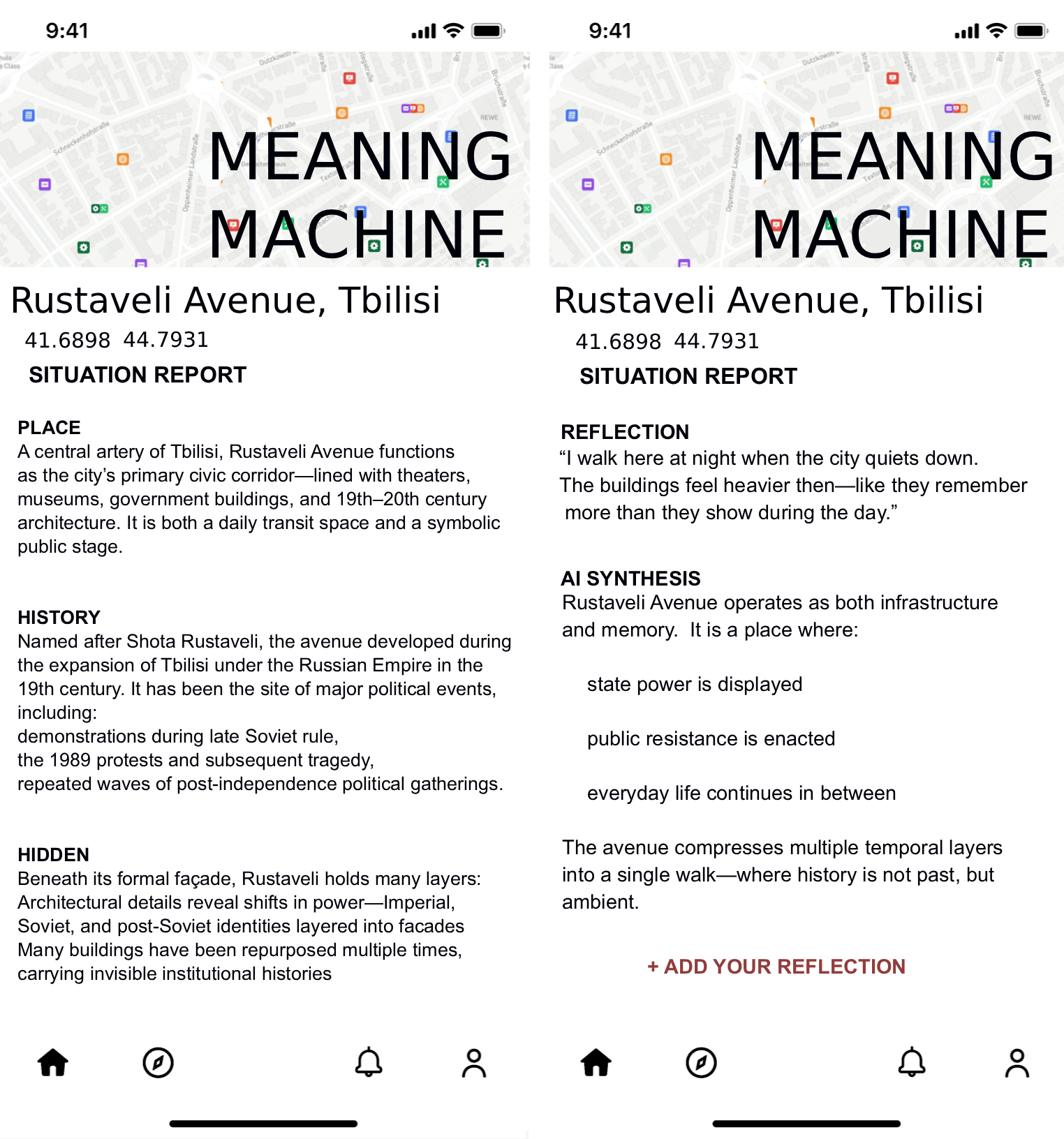
Basically, the Meaning Machine is a location-aware platform/app that generates narratives about places and allows users to contribute their own observations, memories, and reflections. When someone opens the app, the system detects their location, produces a short situational report drawing on historical and geographic data, and invites them to add their own voice. Those contributions are stored and become visible to future visitors at the same location.
One way to understand the Meaning Machine is by contrasting it with the kinds of platforms people already use to navigate cities. Ending up in Tbilisi, Georgia has been a great opportunity to explore this project because the city is loaded with history, architecture and changing meanings. A Google Maps pin on a street in Tbilisi might tell you that a restaurant closes at 10 p.m. The Meaning Machine might tell you that the same street once housed a clandestine printing press used by revolutionaries in the early twentieth century. Both pieces of information are useful, but they serve different purposes.
The difference also appears in the kinds of contributions the platforms invite. Google reviews are largely transactional: Was the food good? Was the service slow? The Meaning Machine encourages a different type of participation. Users are invited to contribute observations, feelings, memories, interpretations, and fragments of local knowledge. Instead of accumulating ratings, the system accumulates stories.
Over time, ideally, this creates a different kind of archive. Conventional mapping platforms collect evaluative data about businesses and infrastructure. The Meaning Machine collects traces of human experience.
The current prototype generates a structured report with five layers: